
Shopware 5 in 2026: Why It's Time to Move to Shopware 6.7
When we first published this comparison in 2024, the question was still: is the switch worth it? By now, that question has been answered. Shopware 5 was officially discontinued at the end of July 2024, Shopware 6.7 has been the current version for over a year, and 2026 brought new legal obligations in Germany and the EU that a frozen system can only meet with a lot of tinkering.
If your shop is still running on Shopware 5, this article is for you. It covers what has changed, where the risks are and how the move works.
What “end of life” actually means for your shop
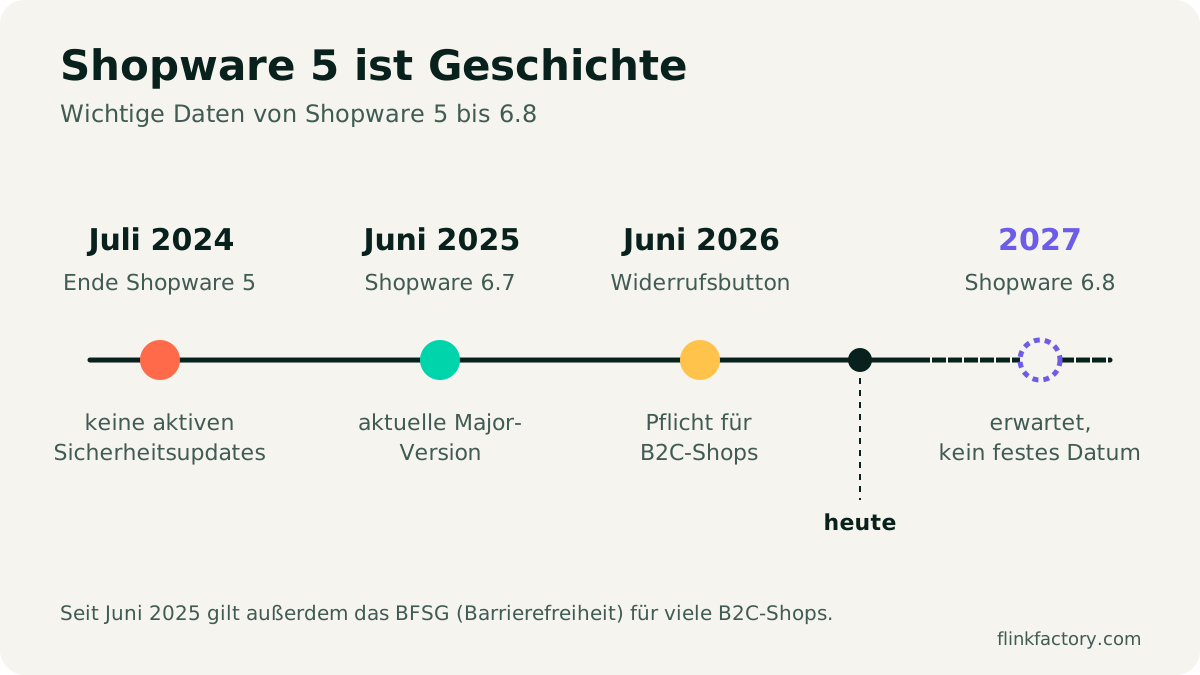
Shopware stopped developing Shopware 5 at the end of July 2024 (endoflife.date). Since then, there have been no active security updates. Shopware only reacts when vulnerabilities are reported, and you can’t plan around that. Third parties such as safefive offer commercial long-term support. That buys you time, but it’s no substitute for ongoing development.
What this means in practice:
- Security: Every newly discovered vulnerability puts customer data and payment processes at risk.
- PHP version: Shopware 5 is tied to older PHP versions. Hosting providers are gradually dropping them or charging extra.
- Plugins: Many vendors no longer maintain their Shopware 5 extensions, including payment and shipping providers.
- New obligations: Legal changes no longer arrive as updates. You have to build them yourself.
New obligations in 2025/2026: this is where it gets tight
Two regulations hit B2C shops selling in Germany especially hard:
- Accessibility (BFSG): Since June 28, 2025, the German Accessibility Strengthening Act (Barrierefreiheitsstärkungsgesetz, BFSG), which implements the European Accessibility Act, has required many online shops to be accessible. Shopware has put a lot of work into making the version 6 storefront more accessible. What this means for your shop is covered in our BFSG checklist for Shopware.
- Withdrawal button: Since June 19, 2026, B2C shops have needed an electronic withdrawal function (the German “Widerrufsbutton”). Shopware ships it for 6.7, but there is no official update for Shopware 5. Details in our article The withdrawal button in Shopware.
Shopware 5 vs. Shopware 6.7
Shopware 6 isn’t an evolution of version 5. It’s a complete rebuild on a modern foundation.
| Shopware 5 | Shopware 6.7 | |
|---|---|---|
| Status | discontinued since July 2024 | current version, monthly updates |
| Technology | Zend Framework, Smarty | Symfony, Twig, API-first |
| PHP | older versions | 8.2 to 8.4 (8.4 recommended) |
| Shopping worlds / layouts | Shopping Worlds | Shopping Experiences with blocks and sections |
| Rules & automation | limited, often via plugin | Rule Builder and Flow Builder, no code |
| Extensions | plugins | plugins and apps (including Shopware Cloud) |
| Headless | limited | Store API and Admin API |
| New obligations (e.g. withdrawal button) | build it yourself | via Shopware updates |
| AI features | none | e.g. Copilot features in the Administration |
The improvements merchants notice day to day
- Shopping Experiences: Build landing pages and category pages with drag and drop. With extensions like Grid Builder Pro, you can even build your own responsive grid layouts without code.
- Rule Builder: Tie shipping costs, payment methods, prices or promotions to conditions such as cart value, customer group or country.
- Flow Builder: Automate processes, for example sending an email for certain orders or tagging repeat customers.
- Modern Administration: The Administration has been reworked several times in Shopware 6.7. Our review of the 6.7 updates covers the latest changes.
How the migration works
A migration isn’t an update button, it’s a project. The data is transferred by the official Migration Assistant (Shopware Developer Docs): you install the Migration Connector in your Shopware 5 shop and the Migration Assistant in your new Shopware 6 shop. They connect via an API key from the Shopware 5 backend.
- Take stock: Which plugins, customizations and integrations do you really use? Which of them exist for Shopware 6, which will be replaced and which can go?
- Set up the new shop: Shopware 6.7 on an up-to-date server, ideally with the stack from our performance guide.
- Migrate the data: Products, categories, customers, orders, media. The assistant checks the data first and lets you fill in missing mappings.
- Rebuild the theme: The design is rebuilt on top of the Shopware 6 storefront. A good moment to get rid of old baggage.
- Protect your SEO: Redirect all old URLs to the new ones with 301 redirects, or you’ll lose rankings.
- Test and run a delta migration: Shortly before go-live, pull in the orders and customers that came in during the project, then switch over.
Common pitfalls
- Underestimating plugin replacements: Some Shopware 5 plugins have no direct counterpart. Plan time for alternatives or custom development.
- Free text fields and custom logic: Whatever was customized in Shopware 5 over the years needs to be rethought in Shopware 6. Today, much of it can be done with Rule Builder and Flow Builder, without code.
- Starting too late: Depending on the shop, a migration takes anywhere from a few weeks to a few months. Moving in the middle of the Christmas season is not a good idea.
Conclusion
The question of “whether” is settled. Shopware 5 is discontinued, new obligations keep coming, and Shopware 6.7 is mature. If you start planning now, you can prepare the move for the first quarter of 2027, well ahead of the next major version 6.8, which Shopware has announced for 2027 (Shopware).
Want to move off Shopware 5, or need a plugin that doesn’t exist for Shopware 6? Talk to us. We support migrations and develop the extensions you’re missing.
Sources
You might also like
Shopware 6.7 in Review: What the 2026 Updates Delivered
Eleven minor releases, a withdrawal button, an AI sales channel and new mandatory EU information: here's what Shopware 6.7 brought merchants in 2026, and what to watch out for when you update.
November 9, 2026 · 6 minLegalAccessibility in Your Shopware Shop: BFSG, Cease-and-Desist Letters and a Checklist
Germany's Accessibility Strengthening Act (BFSG) has applied since June 2025, and a second wave of cease-and-desist letters has been rolling since February 2026. What the BFSG means for your Shopware shop, what Shopware 6.7 already covers, and a checklist for testing it yourself.
September 24, 2026 · 8 min