
Agentic Commerce: When AI Agents Shop in Your Shopware Store
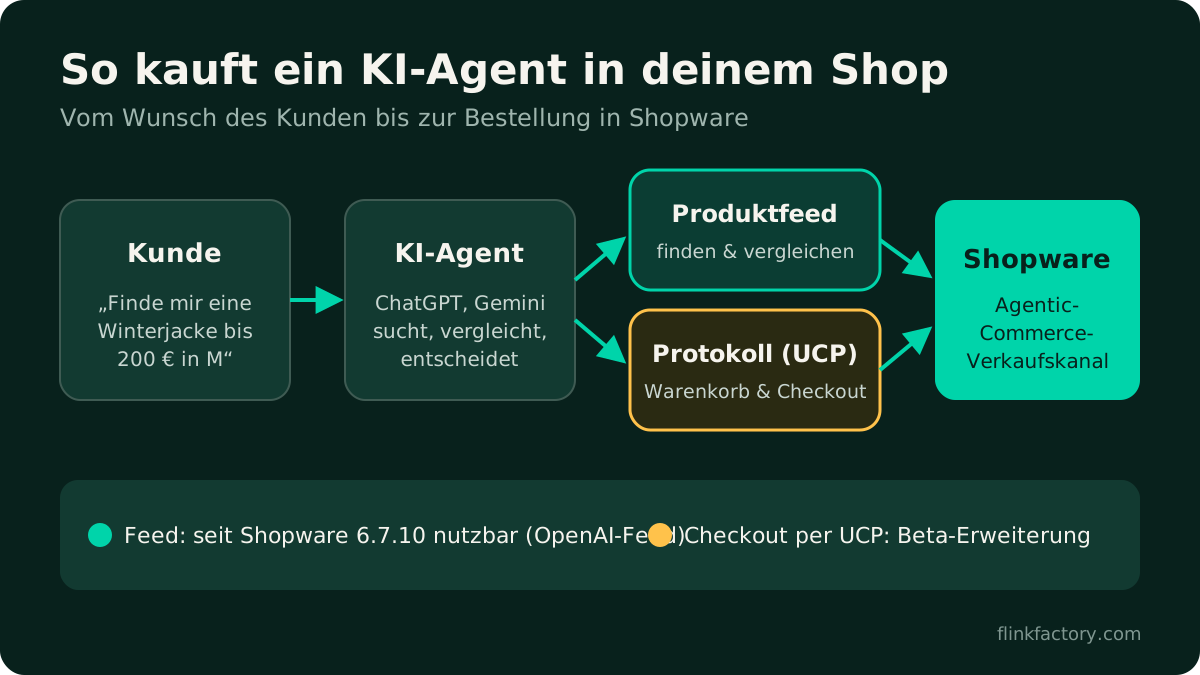
Until now, online shopping worked like this: a person searches, compares, clicks and pays. With agentic commerce, an AI assistant takes over part of that. A customer tells ChatGPT or Gemini “Find me a warm winter jacket under €200 in size M”, the agent searches shops, compares offers – and in the next step, it puts the jacket into the cart itself.
Shopware shipped the first building blocks for this over the past year. At the same time, a lot is still in beta, and a lot depends on OpenAI, Google and others. In this article, we put into perspective what already works, what’s missing, and what you can do right now without jumping on the hype.
What exactly is agentic commerce?
An AI agent is an AI assistant that doesn’t just generate text but uses tools: it fetches product data, checks prices and availability and, if the shop allows it, can carry out actions. In one of its own articles, Shopware quotes Paul Krauss from the agency Team One with a fitting line: a model that only generates text doesn’t buy anything (Shopware: When AI shops for AI).
For an agent to “shop” in your store, it needs two things:
- Data for finding and comparing – usually a product feed with complete, machine-readable information.
- An interface for buying – a standardized protocol it can use to access the cart, checkout and order status.
The protocols: ACP and UCP
So that not every shop has to build its own interface for every AI provider, open standards are emerging. The two most important ones:
| Agentic Commerce Protocol (ACP) | Universal Commerce Protocol (UCP) | |
|---|---|---|
| Initiated by | OpenAI (with Stripe) | Google (with Shopify, Walmart, Target and others) |
| Introduced | Fall 2025, together with Instant Checkout in ChatGPT | January 11, 2026 at the NRF trade show |
| Where the agent buys | ChatGPT | AI Mode in Google Search, Gemini |
| How shops connect | Product feed + checkout interface | Manifest at /.well-known/ucp, connection via API, Agent2Agent (A2A) or MCP |
Sources: Shopware on ACP and Instant Checkout, InfoQ on UCP.
For merchants, this means you don’t have to pick “the one” protocol. Your shop software should speak the common standards, and that’s exactly where Shopware comes in.
What Shopware offers today
In spring 2025, Shopware co-founded the Agentic Commerce Alliance and is working with PayPal, among others, on agents that find, compare and buy products for customers (Shopware). Here’s what was actually shipped in 2026:
| Building block | Since | What it does | Status |
|---|---|---|---|
| Agentic commerce sales channel | Shopware 6.7.10 (May 2026) | Dedicated sales channel with an OpenAI product feed (JSONL), a ready-made feed URL and tracking of orders that come in via AI | in the core, more platforms announced |
llms.txt and agents.md | Shopware 6.7.12 (July 2026) | Per-sales-channel files that explain to AI search engines and agents what your shop offers | in the core |
| ”Agentic Commerce (Beta)” extension | June 2026, currently version 1.4.0 | UCP support for catalog, cart, discounts, checkout and orders; feeds for OpenAI and Google | beta |
Sources: Shopware Release News May, July, Shopware Store.
The sales channel from 6.7.10 automatically filters out invalid products and tracks traffic and orders from AI sources via the existing affiliate logic. That way, you’ll also be able to see later whether the channel is worth it at all.
What’s still missing – an honest look
As exciting as it sounds: for most shops, agentic commerce is still a testing ground in fall 2026.
- The checkout is in beta. The “Agentic Commerce (Beta)” extension is explicitly labeled as beta. According to its store page, it requires at least one dynamic product group and access to packagist.org during installation and updates, and it can’t be installed in cluster setups. Several reviews reported errors after installation or updates. Shopware responded with fixes, and version 1.4.0 disables the extension when the SDK is missing instead of blocking the shop.
- A feed alone doesn’t open a checkout. The feed makes sure agents can find and compare your products. They can only buy once a protocol like UCP is active as well.
- The platforms have a say. According to Shopware, some of the AI providers’ features are currently limited to merchants in the US. Whether and when shops in Germany and elsewhere in Europe can fully participate is out of your hands.
- Legal questions and liability are open. Who is liable if an agent orders the wrong thing? How do withdrawal rights and mandatory information work when no human sees the order page? There’s no established practice for this yet.
Why product data now matters more than your design
A person can be won over by beautiful images and a good home page. An agent sees none of that. It reads data, and it compares you in seconds with every other shop offering the same product.
For an agent to choose your product, it has to be able to answer the customer’s question with your data. “Waterproof?”, “Does M fit at 5’11”?”, “Delivery by Friday?” – if that isn’t clearly in the product data, your offer falls through the cracks.
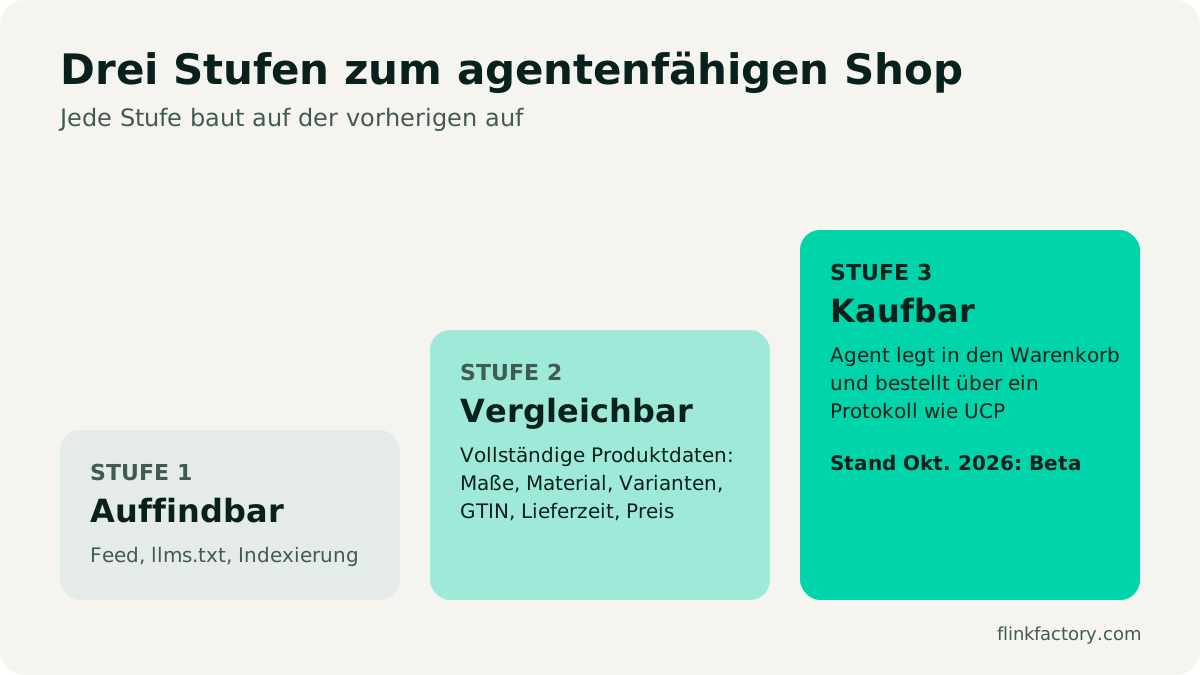
The good part: everything you do for agents pays off today. Clean product data improves your filters, your internal search, Google Shopping and how you show up on price comparison sites.
How to prepare your shop
Our checklist, sorted by effort, from “right away” to “once the channel is mature”:
| Step | What to do | Effort |
|---|---|---|
| 1. Keep Shopware up to date | At least 6.7.12.1, ideally the latest version, so llms.txt, agents.md and the agentic commerce channel are available | low |
| 2. Check product data | Required fields for every product: GTIN/EAN, manufacturer and manufacturer number, material, dimensions, weight, sizes and colors as real variants | medium |
| 3. Write copy that answers questions | Descriptions that answer concrete questions (care, fit, intended use) instead of pure marketing language | medium |
| 4. Maintain delivery times and stock | Agents filter by “available by …” – outdated stock levels cost trust | low |
5. Fill in llms.txt and agents.md | Briefly describe what you sell, to whom and on what terms (shipping, returns) | low |
| 6. Create the agentic commerce channel | Activate the OpenAI feed and work through the error list of excluded products | low |
| 7. Watch the traffic | See in the channel whether any visitors and orders are actually coming from AI sources | ongoing |
| 8. Test checkout via UCP | In staging first, once the extension leaves beta and the platforms admit merchants in your country | later |
Conclusion: prepare, yes – hype, no
Agentic commerce is no longer a “someday” topic: the protocols are in place, the big AI providers are building in purchase features, and Shopware delivers a sales channel, feeds and a UCP connection. But for a typical mid-sized German or European shop, purchases by agents are still a thing of the future in fall 2026. The checkout is in beta, and the platforms are opening up step by step.
What you should do today is unspectacular, yet it pays off immediately: keep Shopware up to date, complete your product data, activate the feed and watch what happens. If you have your data under control now, you’ll be ready when the channel really starts generating revenue.
Want to clean up your product data, connect feeds or properly test the agentic commerce channel? Talk to us. We support you with custom Shopware development.
Sources
You might also like
Shopware 6.7 in Review: What the 2026 Updates Delivered
Eleven minor releases, a withdrawal button, an AI sales channel and new mandatory EU information: here's what Shopware 6.7 brought merchants in 2026, and what to watch out for when you update.
November 9, 2026 · 6 minE-CommerceChristmas Season 2026: Experience Over Discount Wars in Your Shopware Shop
Online sales are growing while retail sentiment is subdued: what the 2026 HDE forecast for Germany means for Shopware shops, and how to stand out from the crowd without joining a pure discount war.
November 5, 2026 · 7 min